Strongman
Strengths and moats. Makes the strongest honest case for what you already have, and where to deepen it.
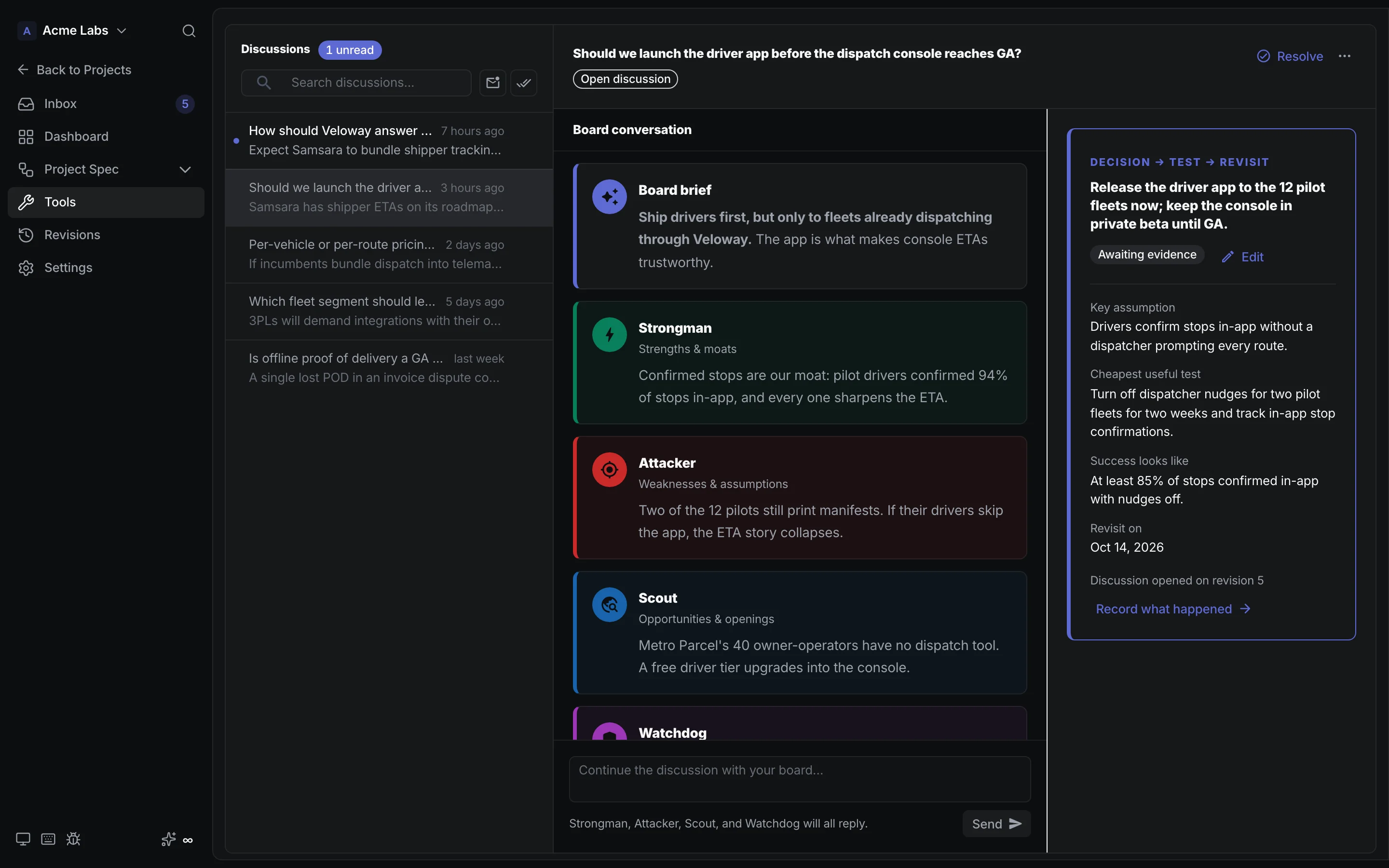
Ask the question that keeps you up at night. Four independent voices answer it from your living spec, your SWOT, and cited market evidence. Then turn their advice into a decision you can test, and revisit when the evidence comes in.
Most AI advice agrees with whoever is typing. Cofounder gives every question to four fixed perspectives, so the uncomfortable answer always has a seat at the table.
Strengths and moats. Makes the strongest honest case for what you already have, and where to deepen it.
Weaknesses and assumptions. Goes straight for the assumption you would rather not test.
Opportunities and openings. Looks for the gap competitors left and the segment nobody serves well.
Threats and countermoves. Names what could take you out, and what to do about it first.
The board works from your published flows, roles, and phases, plus your Live SWOT, your competitor radar, and past board discussions. You don't have to paste the product into a prompt.
Every turn opens with a brief, then exactly one answer from each of the four voices. Each one reaches its own conclusion. No flattery, and no contrarianism for show.
With market intelligence switched on, the board checks current public evidence and cites it. If it can't verify something, it says so instead of pretending it checked.
When the board lands somewhere useful, record it as a decision: what you chose, the assumption underneath it, how you will test it, what success looks like, and when to look again.
The Decisions tab lists every decision the team has made with the board, flags the ones due for review, and lets you send fresh evidence back with Ask board to reassess.
Cofounder brings the cited Live SWOT and the Competition radar under one roof. Steer or pin the insights that matter; the board reads them before it answers.
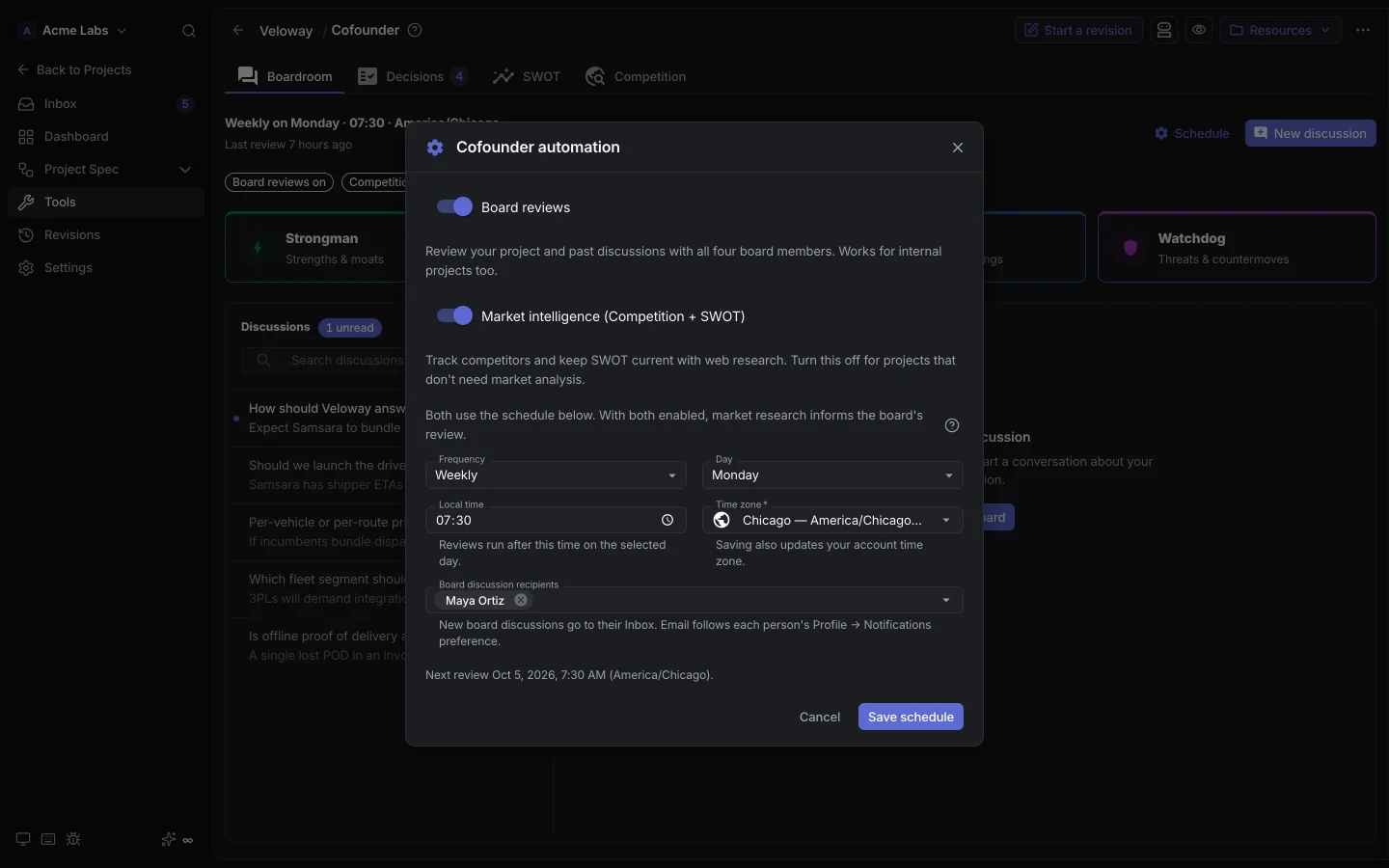
Explore Live SWOTPut the board on a schedule and it reviews what changed in the spec and the market, then reports back. Two independent switches keep you in control of what runs.
Schedule board reviews in your own time zone. A run with nothing materially new says so instead of manufacturing urgency.
A separate switch refreshes Competition, then the Live SWOT, then the board, in that order. It is off by default, so nothing spends credits until you choose.
Every review lands in the CrystalSpec Inbox and links straight to its thread. Email delivery is opt-in for each person.
Cofounder advises; your team decides. It never edits the specification, and its board is AI, not a panel of people. Board runs spend AI credits, and market intelligence stays off until you switch it on. It is a sharper way to think out loud, not an oracle.
Cofounder is a strategy board inside every CrystalSpec project. You ask a product or business question, and four AI perspectives — Strongman, Attacker, Scout, and Watchdog — answer it from your specification, your Live SWOT, your competitor research, and earlier board discussions. You can turn the advice into decisions with a test plan and a revisit date.
No. It is a structured second opinion that has read everything in your project and is never too busy to argue. Decisions stay with your team; the board advises, records, and reassesses when you bring it evidence.
No. Board discussions and decisions live beside the specification and never edit it. Changes to the spec still go through AI proposals that a person approves.
From the project's Competition and Live SWOT tools, and, when market intelligence is switched on, from current public sources the board cites in its answer. When evidence can't be verified, the board states the gap rather than claiming it checked the market.
Anyone who can read the project can read the board. Members with write access ask questions, record decisions, and configure the schedule. Board runs use your workspace's AI credits, and scheduled market intelligence stays off until you switch it on.
Cofounder ships in every CrystalSpec project, next to the spec it reads.


