The agentic product OS
for your business
AI agents build, sell, analyse and teach from one source of truth: specs, tasks, CRM, sites, shops, time and invoices in one workspace. Your team approves what ships.
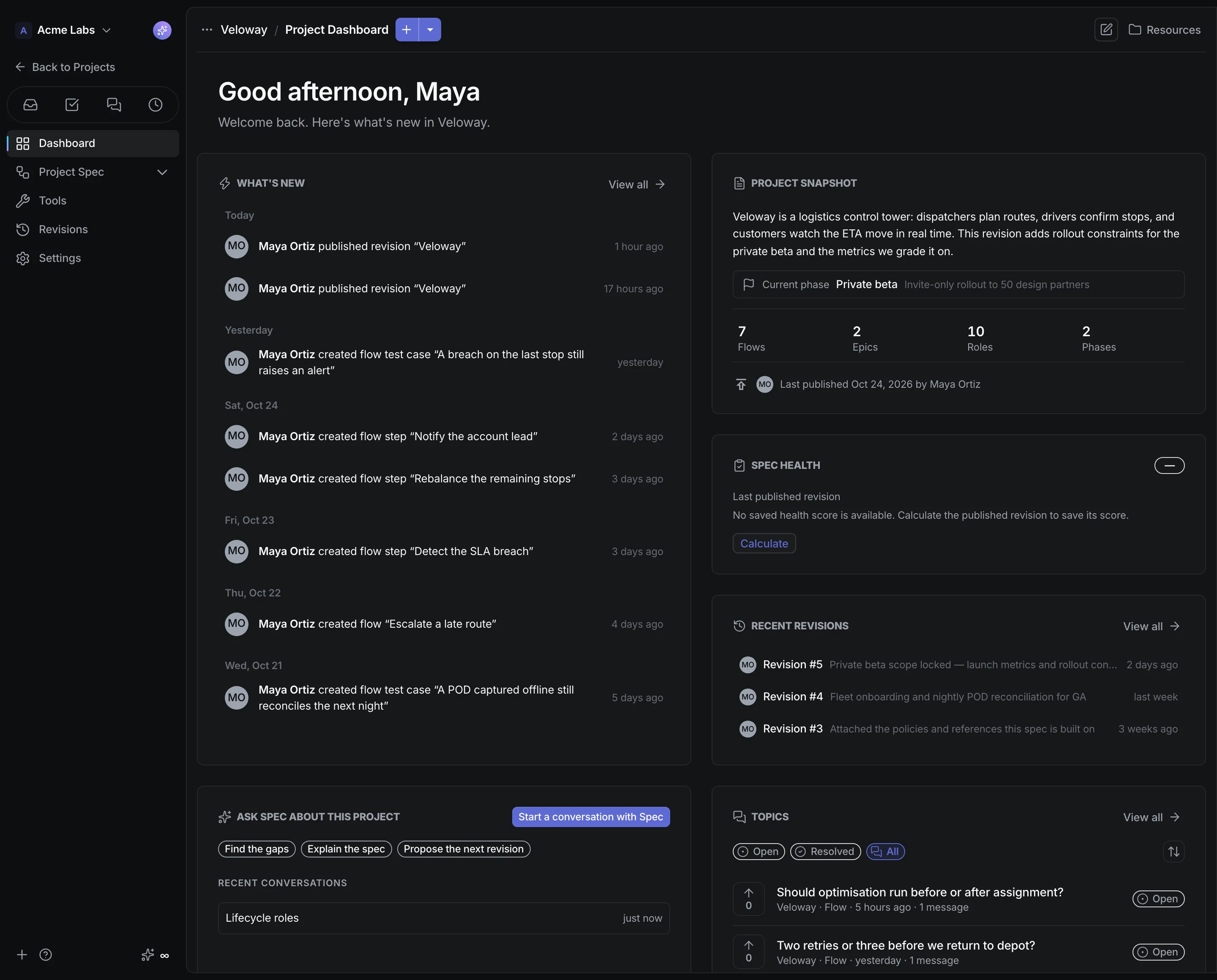
Or start from an idea. AI drafts the first spec your agents work from.
Your business runs on seven tools. None of them agree.
“Sales promised something product never heard of.”
Deals, specs and tasks live in the same project, on the same approved revision.
“The agent built exactly what we wrote.”
Coding agents read the approved revision over MCP, not last month's prompt.
“The hours are in one app, the invoice in another.”
Time reports become invoices in the same workspace.
“Which version did the client actually sign off?”
Every revision is versioned and revertible, and contracts go out through Sign.
Seven tools drift. One OS doesn't.
One kernel. Every tool. Every agent.
The revision your team approved is the kernel. Project tools, workspace tools, your integrations, and your coding agents all run on it, so a change made once reaches all of them.
- Hosted MCP
- GraphQL API
- Signed webhooks
- GitHub · GitLab · Linear · ClickUp tasks
- GitHub & GitLab checks
- Flow events & result commands
- Slack Q&A
- Inbox
- Spec, by text or voice
- Forum & topics
- My Work
- Cmd+K
- Prototypes
- Public share links
- Flows
- Data models
- Roles
- Test cases
- Phases & epics
- Knowledge: glossary, documents, resources
- Versioned · human-approved
AI does the work. People keep the final say.
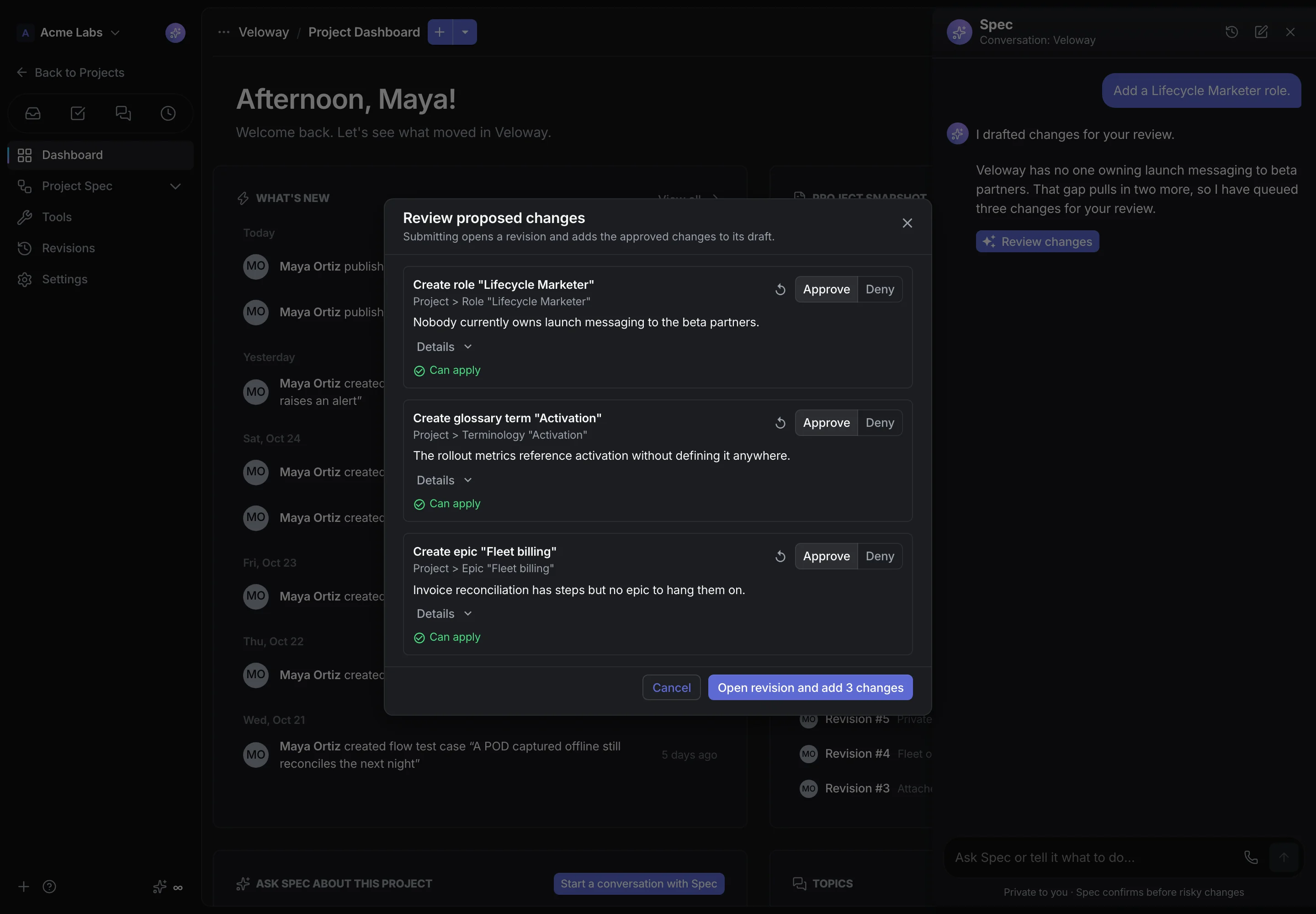
AI proposes. You decide.
Every change the AI wants to make arrives as a structured proposal. Nothing writes until a person approves it, and rejected ideas stay on the record.
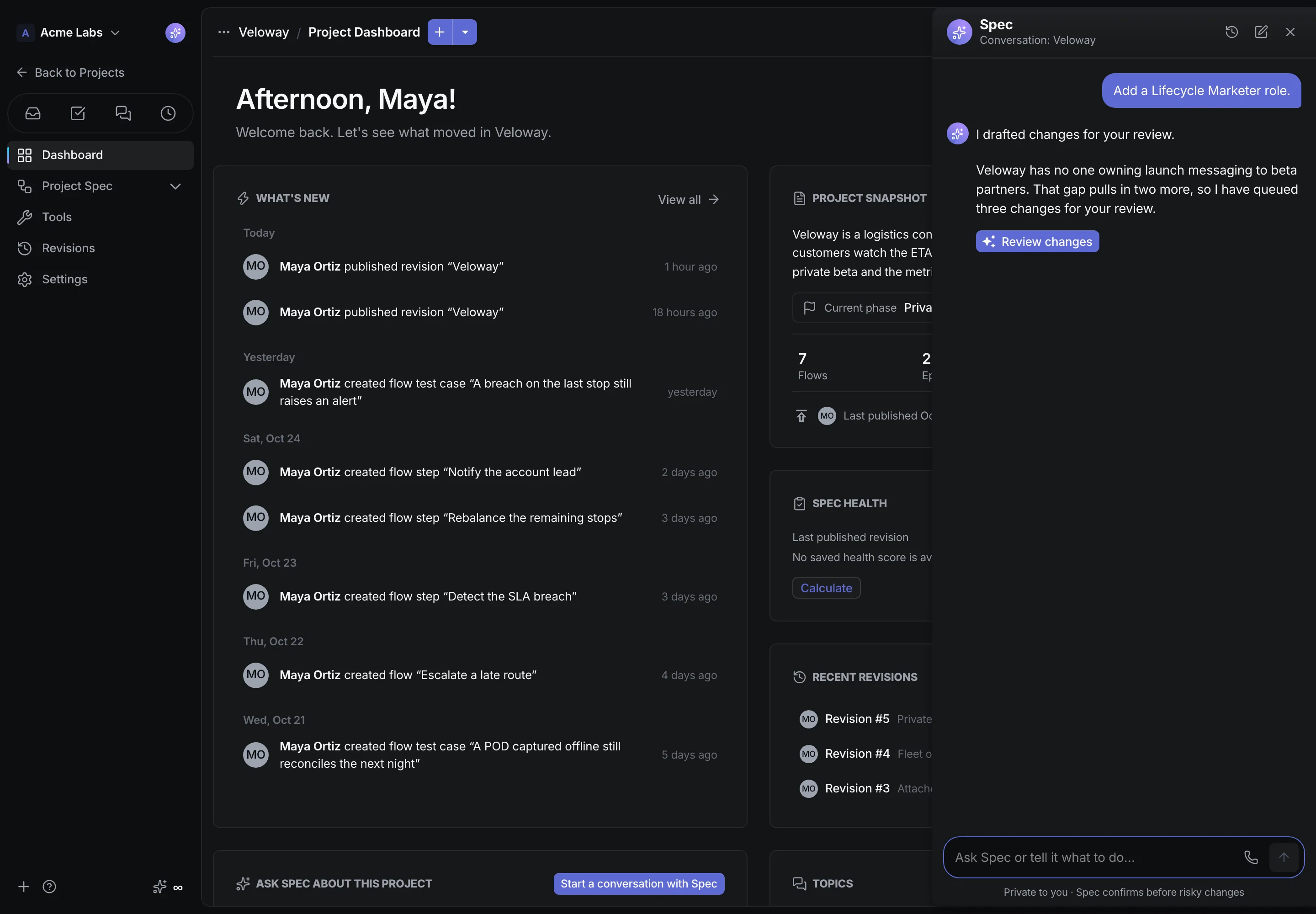
Ask it anything. Hand it the busywork.
Talk to Spec by text or voice. It reads the project, opens tasks, and drafts changes for your review, and it asks before anything risky.
From approved change to shipped task.
Publishing turns approved changes into tasks in the Tracker or in GitHub, GitLab, Linear, and ClickUp. Runs hand work between people and software.

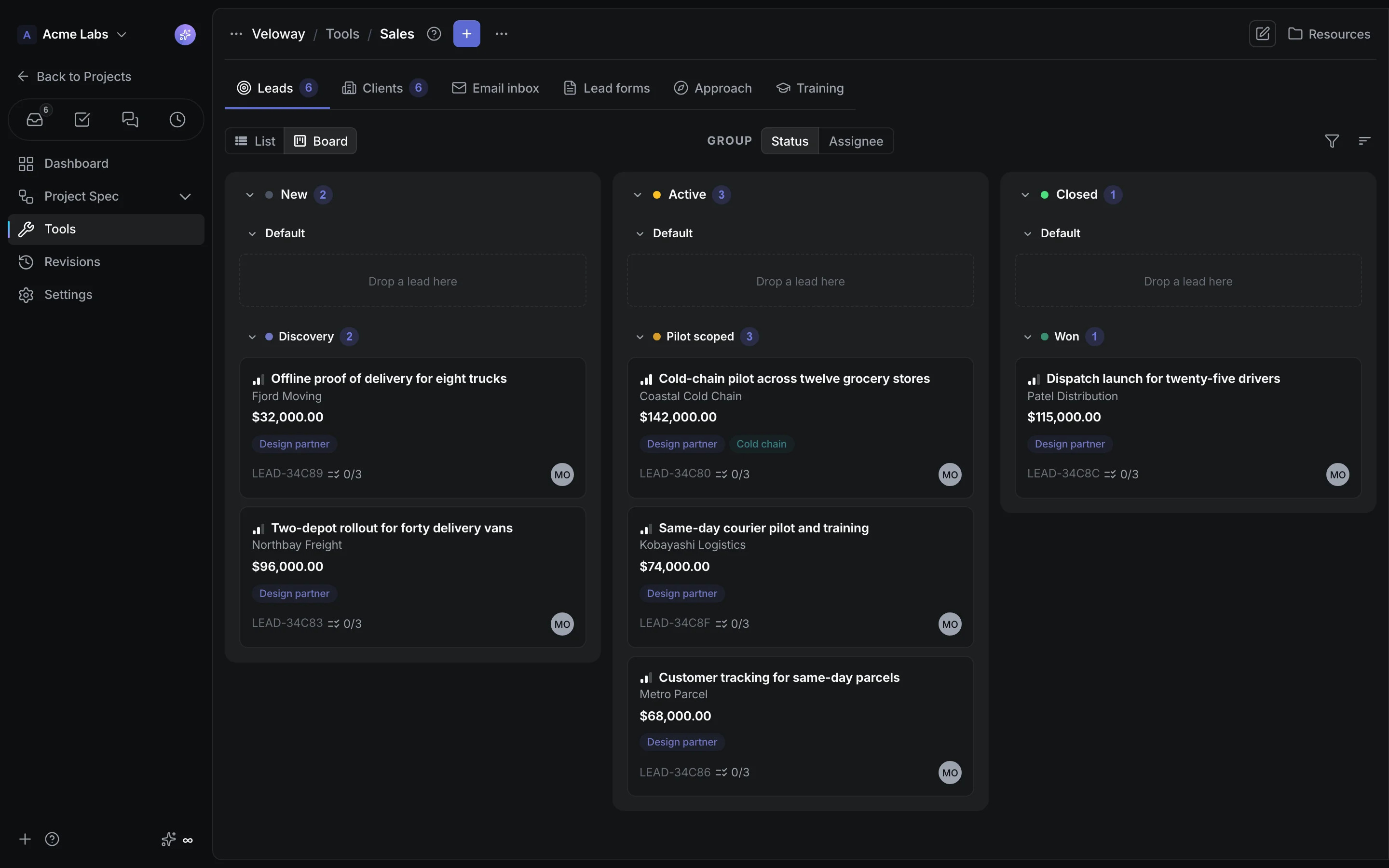
Sell what you actually build.
A CRM inside the same project: leads, pipelines, inbound email review, and lead forms, plus AI buyers to practise the pitch on.
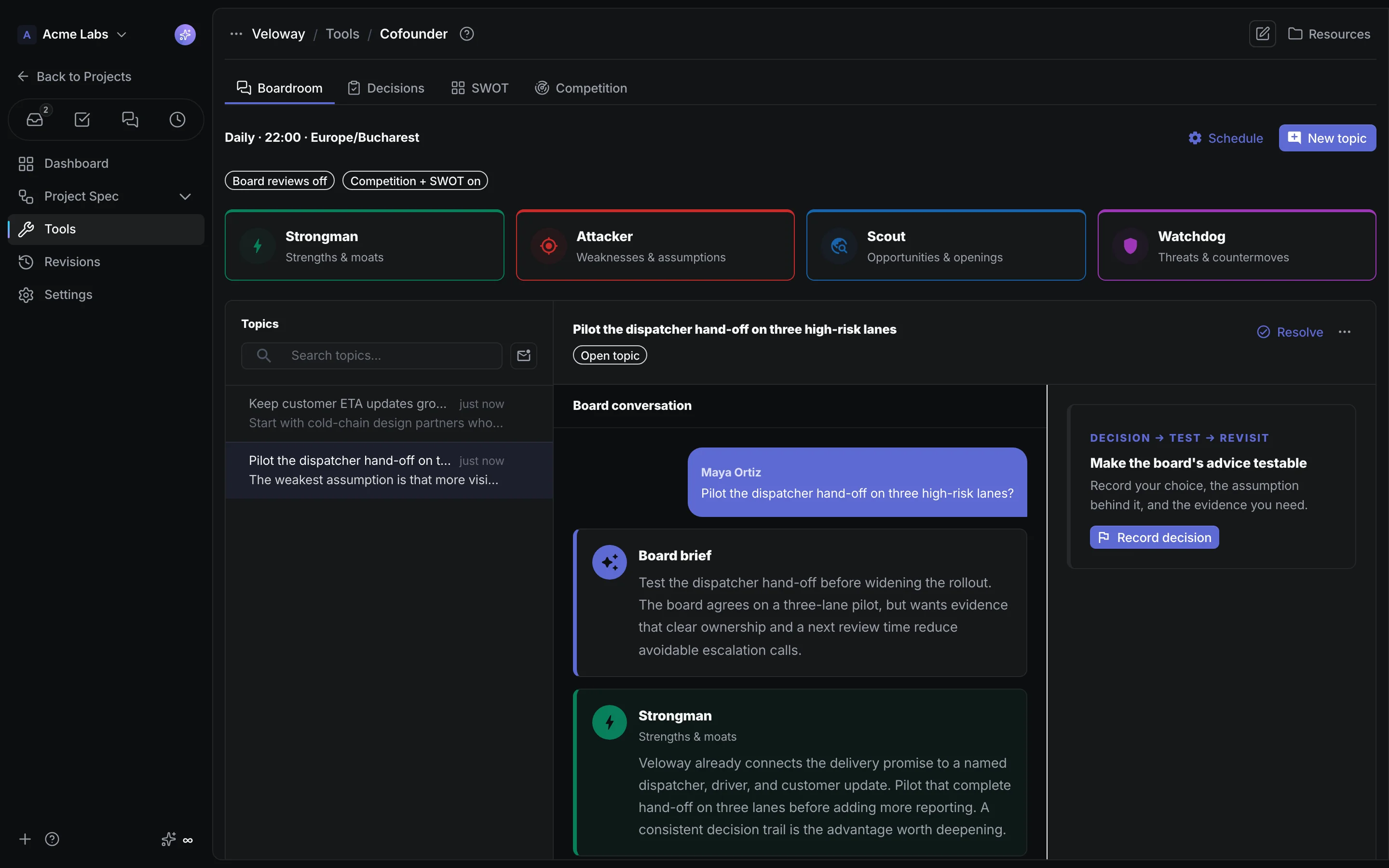
A board that pushes back.
Four AI voices answer your hardest question from the spec, your SWOT, and cited market evidence. Turn the advice into a decision you can test.
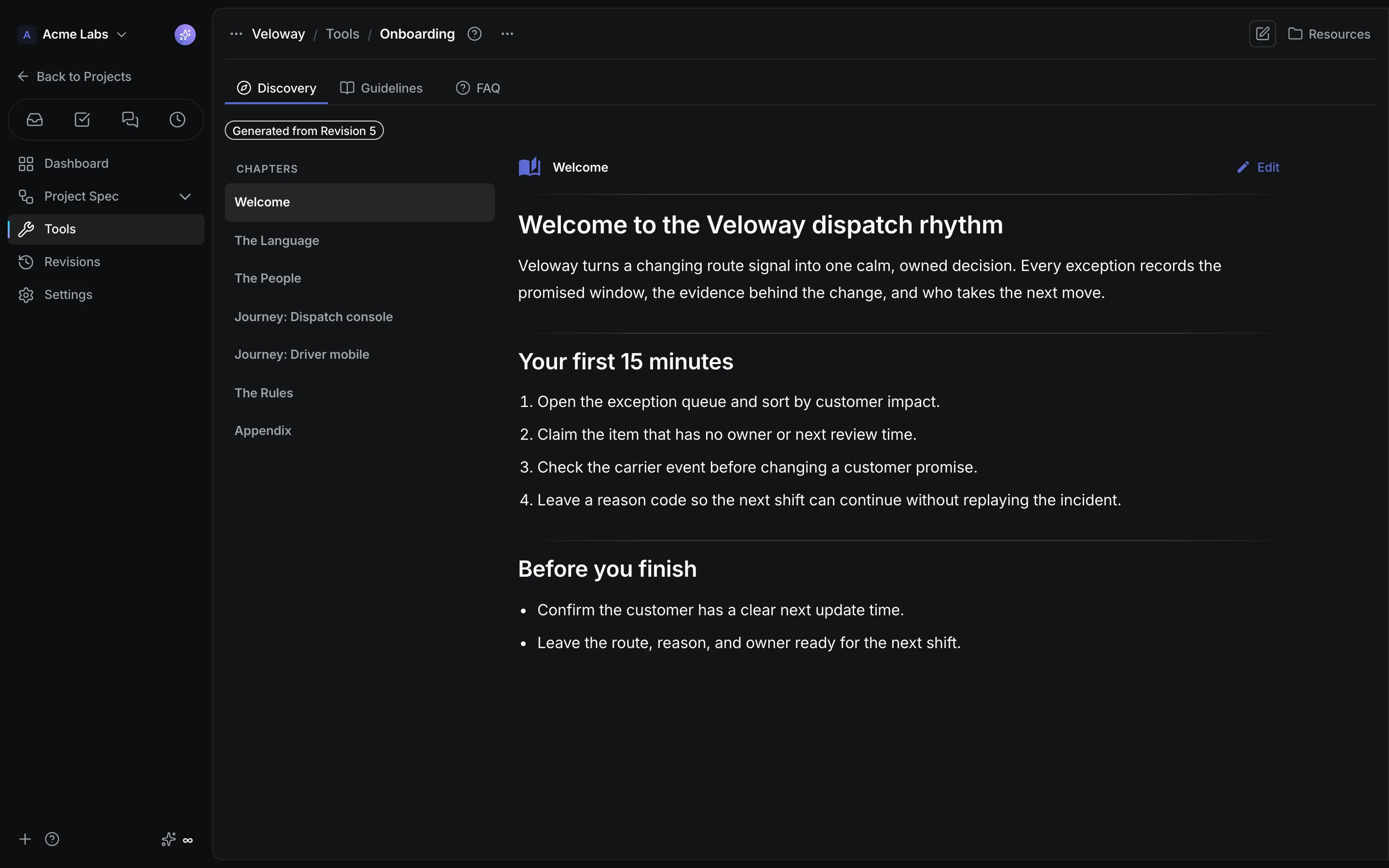
New people learn what is true today.
Onboarding books and role FAQs are written from the approved revision, so they change when the product does. Team quizzes check that it stuck.
Agents propose. You approve. The business runs on it.
Describe
Describe the product or the business. AI drafts flows, roles, data, and a plan.
Approve
Every AI change arrives as a proposal. Accept or reject each one.
Run
Tools for building, selling, teaching, and running the team read the approved revision.
Connect
Coding agents, GitHub, GitLab, Linear, ClickUp, Slack, and webhooks hear every publish.
Change it once. Everything downstream hears it.
- Edit
- Approve
- Publish
- Everywhere
- Coding agents
Claude Code and Cursor read v13 over MCP.
- GitHub · Linear · ClickUp
Atomic task pushed: Queue POD captures offline, linked back to v13.
- Webhooks
revision.published, HMAC-signed.
- Slack
“Does POD work offline?” Answered from v13.
- Cofounder
The next board review reasons from v13.
- The whole team
Everyone sees v13, with an AI change summary.
Integrations are optional and set up per project. The spec never changes without an approval.
Every tool your business runs on.
Repository checks
Paid teams check GitHub and GitLab changes against their spec and enabled compliance frameworks.
Run the business around every project.
Owners and admins switch optional tools on per workspace and set each member’s access level.
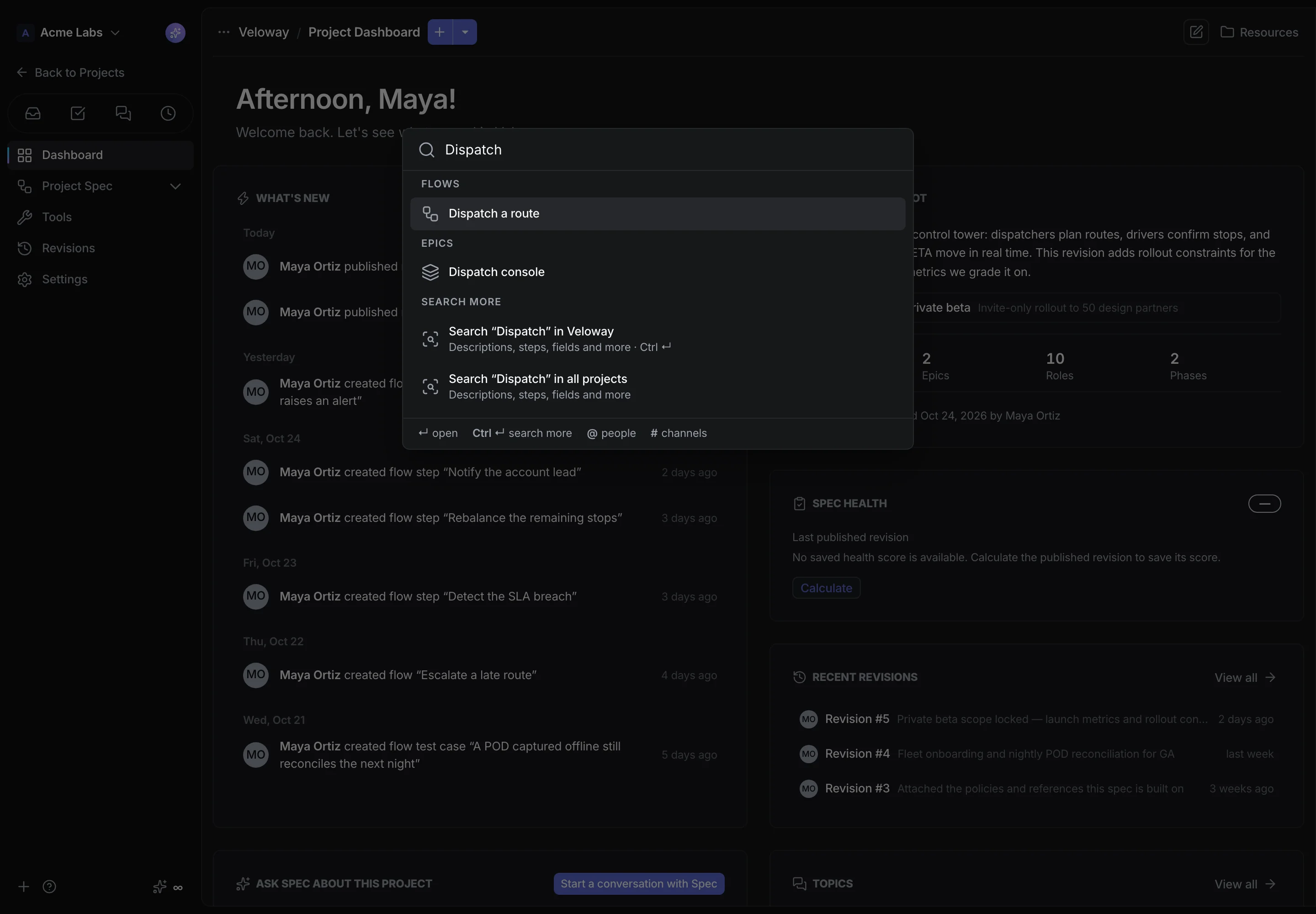
Jump anywhere with Cmd+K
Search flows, steps, models, and terms. Land with the editor open.
The approved source every agent reads.
Branching flows
Steps, sub-flows, decision points, live diagrams.
Full-screen prototypes
Click through a flow as a generated UI, before anyone builds it.
Data models
Typed fields, enums, references. Hand-built or generated.
Test cases
Verification on every flow. QA starts from the spec.
Knowledge library
Glossary, long-form documents with PDF export, links, and files. One vocabulary.
Field history
Who introduced it, every change, the reason recorded.
Inbox & @Spec
One Inbox for notifications, discussions, and assigned work. Ask Spec by text or voice.
Public share links
Read-only live spec. Visitors can ask AI questions.
Cmd+K
Search every flow, step, model, term, and tool, across projects.
PDF & DOCX
Server-rendered export when someone wants “the document.”
Slack Q&A
@Spec answers from the published revision.
Bring your own AI key · pilot
Invited paid teams connect OpenRouter and pay their provider directly.
Read how the work gets done.
Start free. Make room for your team.
Keep creating on Free, or add teammates, more AI, and credit top-ups with Team.
Free
A lasting home for your own projects.
- Unlimited projects · 1 member
- One Free workspace per verified account
- 500 AI credits each month
- 5 GB of uploads
- Free AI · no-training routing
- Bounded AI replies · no web search
- Versioned revisions & publishing
- Read-only public sharing
Free AI use is covered by our Terms and Conditions.
Start freeTeam
Every member, including the owner.
Solo paid: $5/mo. Two members: $10/mo. Five: $25/mo.
- Unlimited projects
- 500 AI credits per member in one shared pool
- Light & Smart AI
- Spec exports, add-ons & credit top-ups
- Push to GitHub, Linear & ClickUp
- MCP, GraphQL, webhooks & PDF export
Add capabilities per project
Landing, Shop, and Backend are separate upgrades: $10 each per project per month, on Free or Team.
Landing and Shop each include 100 GB of origin transfer per month, then $0.10/GB. Cached CDN traffic is excluded. Backend includes 1 million requests per month, then $1 per million. See measured usage and monthly reports in your workspace; additional usage is billed after the month closes.
Monthly AI credits are shared: three paid members receive 1,500 credits, and any member can use the pool. Upgrade to Team to buy credit top-ups.
Prices are in USD; applicable taxes are calculated at checkout. Start with one permanent Free workspace. No trial, no countdown, and no credit card required. Own up to 10 workspaces, with at most one Free workspace at a time. Pay for your existing workspace before creating another Free one. If a downgrade creates a conflict, the newer Free workspace becomes read-only until resolved.
Questions, short answers.
What does "agentic product OS" mean?
One workspace where AI agents and people run a product business from the same approved source. The AI drafts specs, sites, backends, documents, and replies as proposals or previews, and a person approves what ships. Project tools for building, selling, analysing, and teaching, and workspace tools for chat, time, invoicing, signatures, stock, and domains all read that source. Coding agents connect over MCP.
Can I bring my own AI key?
BYOK is a pilot for invited paid teams. A team owner or admin connects an OpenRouter key and chooses separate normal and Smart models. OpenRouter bills the team directly; these requests consume no CrystalSpec credits. Your subscription still applies. A failed or paused connection does not silently switch to paid CrystalSpec credits. Contact support@crystalspec.com about pilot access.
Is CrystalSpec a project management tool?
Not a ticket tracker first. CrystalSpec defines the product — flows, roles, data models, decisions, and test cases — and runs the work around it: spec-linked tasks and runs, strategy, sales, landing sites, shops, forms, backends, and onboarding all read the same published revision, while workspace tools handle chat, time, invoices, signatures, inventory, and domains. Teams with an existing tracker can push atomic tasks to GitHub, GitLab, Linear, and ClickUp instead.
Can the AI change my spec without me knowing?
No. The assistant only produces proposals. Each is validated, waits for your approval, and is recorded. Rejected proposals stay visible.
How do AI credits work?
One Free workspace per verified account receives 500 AI credits each month, subject to Free model and usage limits. Creating, deleting, or transferring workspaces does not reset the allowance. Paid teams get 500 credits per billed seat monthly, in one shared pool. 500 credits cover $5 of AI usage at CrystalSpec rates; credits are not cash. Included credits reset monthly and do not accumulate. Paid teams can buy $10 top-ups for 1,000 credits, valid for 180 days. Reviewing proposals is free. On Free, wait for the monthly refresh or upgrade when your credits run out.
Can I pay annually, and how much upload storage is included?
Team is $5 per member monthly or $60 per member billed annually, with no annual discount. Both plans include 5 GB of uploads per workspace. Paid workspaces get 1 GB more for each billed seat above five. Upload storage is a capacity limit, separate from project hosting transfer; contact support if you need more storage.
What if two people edit at once?
One draft at a time. The first editor locks the draft; everyone else sees the published version. Publish, then the next change starts from there.
Can coding agents read the spec?
Yes. Hosted MCP for Claude Code, Claude Desktop, and Cursor; GraphQL API; signed webhooks on publish. Spec exports, including PDF and DOCX, require a paid plan.
Do I need a credit card to try it?
No. Each verified account gets one permanent Free workspace: unlimited projects, 1 member, and 500 AI credits each month. There is no trial or expiry. Team is optional at $5 per member per month, including the owner. Adding a second member requires Team: two members cost $10/month.
What limits apply to Free AI?
Free uses a low-cost model route, limits each provider response to 8,192 output tokens, and does not include Smart AI or web search. A separate monthly fair-use budget can pause Free AI before all 500 credits are spent. Every provider attempt, including retries, must fit within the remaining spending budget before it starts. Large requests can require more available budget than their final charge. Upgrade for paid-only AI tools.
What does upgrading from Free unlock?
Team unlocks additional teammates, Light and Smart AI, repository AI and document-maintenance automation, spec exports, and credit top-ups. Both plans include unlimited projects. Landing, Shop, and Backend are separate $10-per-project monthly upgrades available on either plan. Managed AI uses no-training provider routing on both plans. Your existing work stays in the same workspace when you upgrade.
Can Free AI use my data for training?
No. CrystalSpec does not train models on your projects. Managed AI on Free and Team uses provider routes that exclude training on your prompts and project context. Retention and abuse monitoring follow provider terms. If you bring your own key, your provider terms apply.
Something else? Start free →